
Last Updated: March 27, 2025
So you’re tired of pushing a mower around every weekend. Maybe your property has some challenging terrain, or you just want your weekends back. Either way, you’ve probably stumbled across two main options: remote control lawn mowers and robotic mowers (sometimes called robot lawn mowers).
But here’s the thing — they’re not the same thing at all. And choosing the wrong one for your situation is an expensive mistake.
I spent the last few weeks digging into the latest models from industry leaders. Here’s what actually matters when you’re deciding between an RC mower and a fully autonomous robotic mower.
What Is a Remote Control Lawn Mower?
A remote control lawn mower (also called an RC mower) is exactly what it sounds like: a motorized mower that you operate via remote control, usually from a distance of 50-200 meters depending on the model.
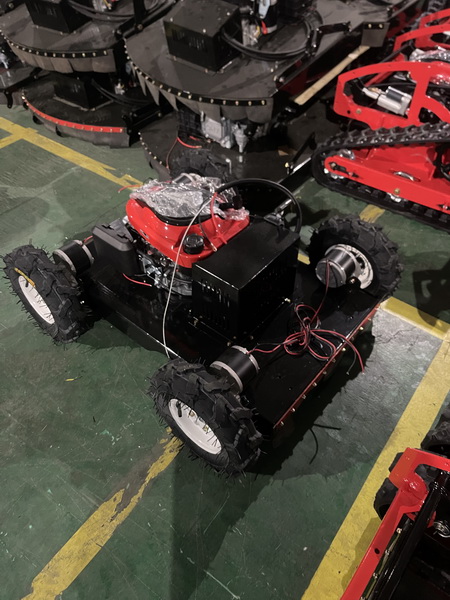
These aren’t toys. Modern RC mowers are serious machines built for:
- Steep slopes (some handle up to 50-60 degree inclines)
- Rough terrain — rocks, roots, uneven ground
- Overgrown areas that would choke a regular mower
- Ditch maintenance and roadside clearing
- Commercial landscaping where precision matters
The operator stays at a safe distance while the machine does the dangerous work. That’s the whole point.
What Is a Robotic Mower?
A robotic mower or robot lawn mower is fully autonomous. You set it up, define the boundaries (either with perimeter wire or GPS/app-based mapping), and it mows on a schedule without any human intervention.
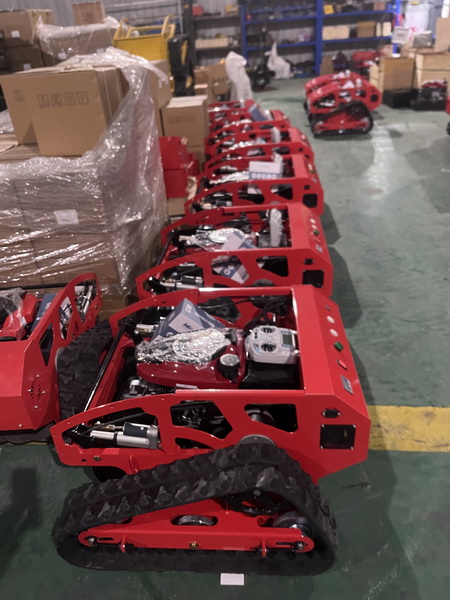
Leading manufacturers dominate this space with machines designed for:
- Regular maintenance mowing — keeping grass at a consistent height
- Flat to moderately sloped lawns (typically up to 30-45% grade)
- Hands-off convenience — set it and forget it
- Quiet, daily operation — many run at under 60 decibels
The Real Differences That Matter
| Feature | Remote Control Lawn Mower | Robotic Mower |
|---|---|---|
| Control | Manual remote operation | Fully autonomous |
| Best terrain | Steep slopes, rough ground, overgrowth | Flat to moderate lawns, maintained grass |
| Slope handling | Up to 50-60° | Usually 15-30° max |
| Cutting frequency | On-demand, as needed | Daily or scheduled |
| Labor required | Operator present | None after setup |
| Initial cost | $3,000-$15,000+ | $800-$5,000+ |
| Maintenance | Mechanical, engine-based | Battery, software updates |
When to Choose a Remote Mower
After looking at the specs and talking to a few landscaping contractors, here’s where an RC mower makes sense:
You have dangerous terrain. If you’re dealing with slopes over 30 degrees, ditches, or embankments, a robotic mower simply won’t handle it. Specialized machines are marketed for ‘slope mowing’ applications where sending a human with a push mower is genuinely dangerous.
You need occasional heavy cutting. Got a field that gets overgrown between cuts? A remote mower can power through tall grass and thick weeds that would stall an autonomous unit.
Precision matters. Commercial operators often prefer RC mowers because they can see exactly what the machine is doing and maneuver around obstacles in real-time.
You’re a remote mower supplier or contractor. If you’re in the business of maintaining difficult properties, an RC mower is a tool that pays for itself by letting one operator handle jobs that used to require crews.
When to Choose a Robotic Mower
On the flip side, a robot lawn mower is the better fit for most homeowners:
You want zero involvement. The whole pitch is ‘Your Perfect Lawn. Zero Effort.’ You literally place it on your lawn and it maps everything itself. No perimeter wires, no programming.
Your yard is relatively normal. If you’ve got a flat suburban lawn under 0.5 acres, a robotic mower will handle it beautifully.
Noise matters. Traditional mowers run at 85-90 decibels. Robot mowers? Often under 60. You can run them at night without annoying the neighbors.
You hate the weekly mow. The whole point of these machines is daily micro-cuts that keep your lawn consistently trimmed. No more ‘it’s Saturday, I have to mow’ dread.
What About Hybrid Options?
Here’s where it gets interesting. Some manufacturers now offer Autonomous Mowing Robots that bridge the gap — machines that can run autonomously on simpler terrain but switch to remote operation when things get tricky.
Advanced systems claim ‘centimeter-level positioning’ with AI vision technology, suggesting the line between remote and autonomous is blurring.
For most buyers in 2025, though, you’re still choosing between:
- Full autonomy (robotic mower) for convenience
- Full control (RC mower) for capability
Pricing Reality Check
Let’s talk numbers because this is where a lot of people get surprised.
Entry-level robotic mowers start around $800-$1,500 for basic models that handle small, flat lawns. Mid-range units run $2,000-$3,500. Premium systems can push $4,000-$5,000+.
Remote control lawn mowers are a different category entirely. You’re looking at $3,000 minimum for a decent residential unit, with commercial models from remote mower suppliers running $8,000-$15,000+. These are professional-grade machines.
Bottom Line
If you’re a homeowner with a standard lawn who just wants to reclaim your weekends, get a robotic mower. The technology has matured significantly — today’s units actually work without constant babysitting.
If you’ve got challenging terrain, steep slopes, or you’re a professional who needs to tackle overgrown properties safely, a remote control lawn mower is the only sensible choice. The capability gap is real.
And if you’re somewhere in between? The emerging hybrid autonomous/remote machines might be worth watching, but they’re still premium-priced and not quite mainstream yet.
Have questions about a specific property or use case? Drop a comment below — I’ve been down the spec sheet rabbit hole on most of the major brands and can point you toward the right machine for your situation.