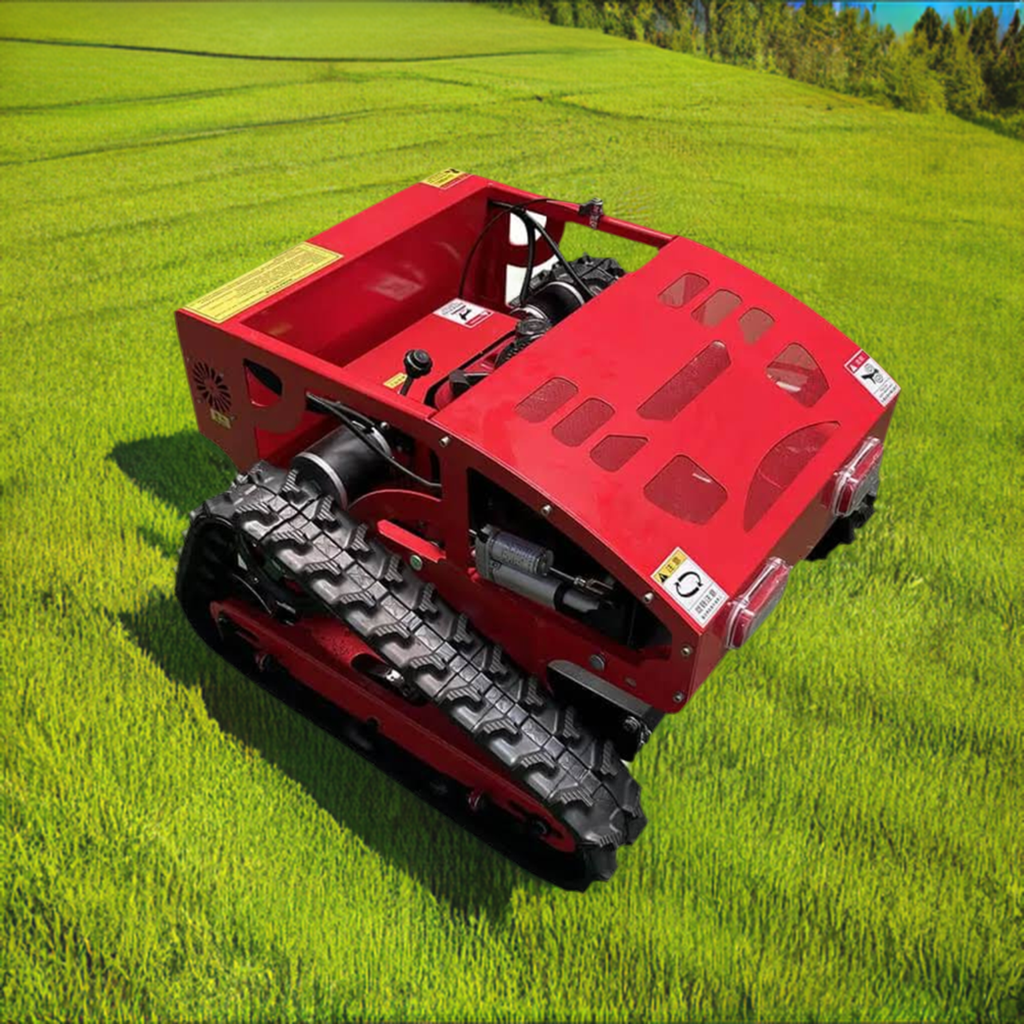
- What are the most important specs I should compare before buying a remote control lawn mower?
Conclusion: Focus on power, slope capability, battery life, and safety features first.
You should compare motor power, maximum slope angle, cutting width and height range, battery capacity, runtime, remote control distance, and built-in safety systems like emergency stop and tilt protection. - How do I choose the right mower model for steep slopes and rough terrain?
Conclusion: Choose a tracked, high-torque, low center-of-gravity model.
For steep and uneven terrain, prioritize strong traction, anti-slip design, and stability. Tracked mowers usually perform better than wheeled ones in these conditions. - What cutting width and cutting height should I look for for commercial use?
Conclusion: Go for a wider cutting deck and adjustable cutting height range.
A cutting width of 50–80 cm or more improves efficiency, while an adjustable cutting height (around 20–150 mm) ensures flexibility across different grass conditions. - How long does the battery typically last under real working conditions?
Conclusion: Expect around 2–5 hours of real-world runtime.
Actual battery life depends on terrain, grass density, and slope, with tougher conditions reducing runtime. - What is the charging time, and does fast charging affect battery life?
Conclusion: Charging usually takes 4–8 hours, and frequent fast charging may reduce battery lifespan.
While fast charging improves efficiency, long-term use can impact battery health, so balance speed and longevity. - Can this mower handle thick grass, tall grass, and uneven ground reliably?
Conclusion: Yes, if it has sufficient power and a heavy-duty cutting system.
Performance depends on motor strength, blade design, and chassis clearance, with professional models handling tougher conditions better. - What is the maximum slope angle it can safely work on?
Conclusion: Most models handle slopes between 30° and 55°.
Tracked systems generally offer better performance and safety on steeper inclines compared to wheeled designs. - How far is the remote control range in open areas and in real job sites?
Conclusion: Typically 200–500 meters in open space, but less in real conditions.
Obstacles and interference can reduce the effective range to about 100–300 meters on job sites. - Does it perform better on flat lawns, hills, or mixed terrain?
Conclusion: Performance depends on the design and intended use.
Wheeled models suit flat lawns, while tracked models excel on hills and mixed terrain. - What type of traction system is better for my use case: tracks or wheels?
Conclusion: Tracks are better for slopes; wheels are better for flat areas.
Tracked systems provide superior grip and stability, while wheeled systems offer higher speed and simpler maintenance. - What safety features should I insist on before placing a bulk order?
Conclusion: Require emergency stop, tilt protection, and remote shutdown.
Additional features like collision sensors, blade guards, and signal-loss auto-stop are also critical for safe operation. - How much maintenance does this mower need each month?
Conclusion: Basic monthly maintenance is required, with more frequent checks for heavy use.
This includes cleaning, blade inspection, battery checks, and tightening components, with weekly checks for intensive use. - Are replacement blades, batteries, and parts easy to source?
Conclusion: Yes, for most mainstream models.
Choosing standardized or widely supported brands ensures easier access to spare parts and lower maintenance costs. - What are the most common failures or complaints buyers report after purchase?
Conclusion: The most common issues involve battery degradation, signal problems, and wear parts.
Users often report reduced runtime, unstable remote control signals, and wear on blades, tracks, or wheels. - Is this model better suited for residential, commercial, or municipal use, and why?
Conclusion: High-power models suit commercial and municipal use, while lighter models fit residential needs.
Commercial and municipal applications require durability and efficiency, whereas residential users prioritize affordability and ease of use.

Contact
albert@robotlawnsmower.com
Whats app
+86-18564252928
Mon - Fri: 9:00 - 17:30
Online store always open